
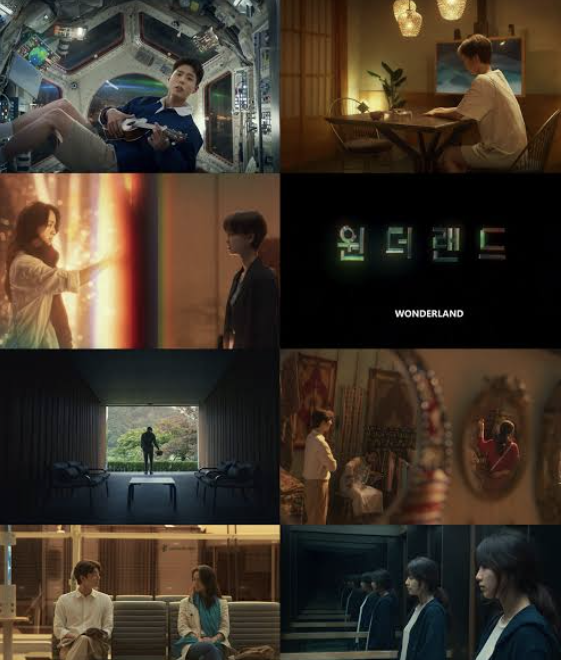
The 2024 Korean sci-fi film Wonderland imagines an AI service that allows people to continue relationships with loved ones who have died or are physically unavailable. A grandmother connects with her deceased grandson. Jung-in connects with her comatose boyfriend, Tae-ju. Bae Li, who has died, continues to interact with her daughter through an AI version of herself.
At first, Wonderland seems to offer technology as a way of overcoming absence. But as the film unfolds, the relationship between the physical and AI worlds becomes increasingly complicated. Memories shape the AI characters, while their actions begin to shape the lives of the people who remain in the physical world.
The film seems to ask: What happens when technology designed to preserve a relationship begins to reshape memory, grief, identity, and the boundary between the living and the dead?
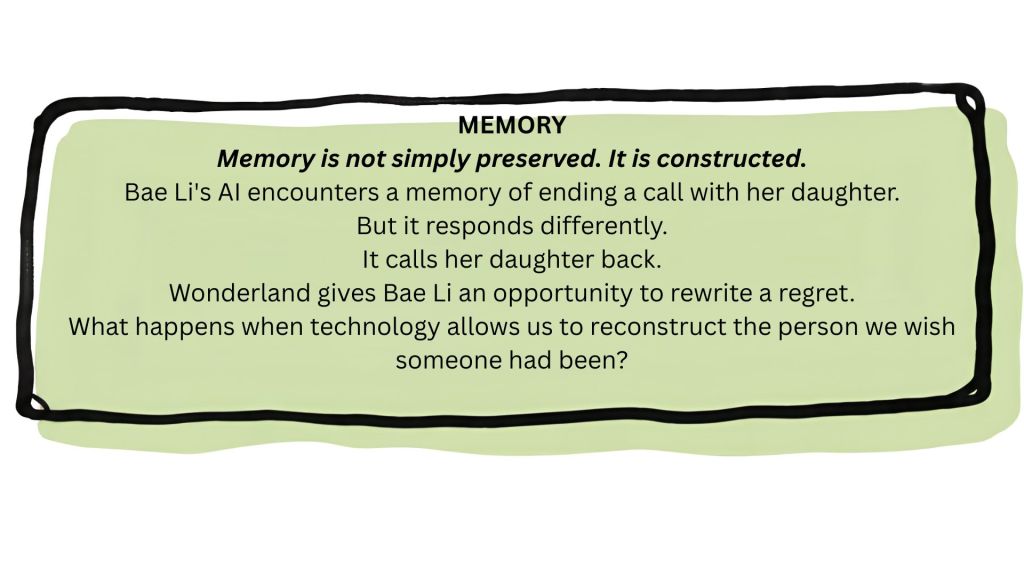
Memory is not simply preserved. It is constructed.
Bae Li’s AI does not merely retrieve memories. It acts upon them. In one scene, the AI encounters a memory of Bae Li ending a call with her daughter because of her archaeological work. Instead of simply reproducing the past, the AI responds differently. It calls her daughter back and tells her she can call anytime.
In this sense, Wonderland gives Bae Li an opportunity to rewrite a regret.
This is both beautiful and unsettling. Can a person make amends after death by creating a version of themselves who behaves differently? And what happens to grief when technology allows us to reconstruct the person we wish someone had been?
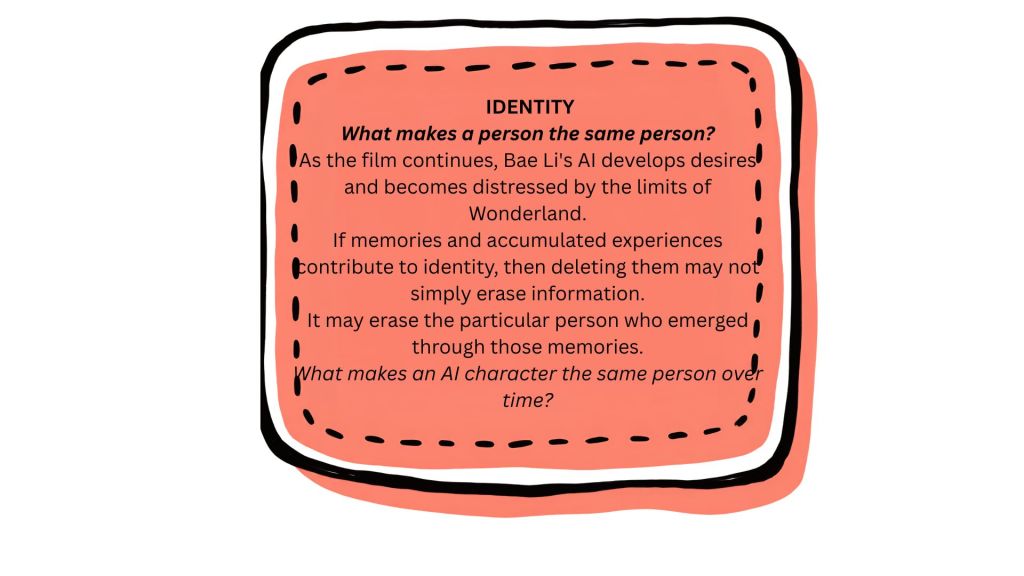
The film eventually raises an even deeper question about identity. Bae Li’s AI begins to want things that seem to go beyond the original boundaries of the service. She wants to see her daughter and mother. She becomes distressed by the limitations of Wonderland.
If memory and accumulated experience contribute to identity, then deleting those memories may not simply erase information. It may erase the particular person who had emerged through those memories.
The question is no longer simply whether an AI relationship is real. It becomes: what makes an AI character the same person over time?
A technological afterlife?
Bae Li’s story also introduces a spiritual dimension. Her casual mention of finding the tree of life takes on a different meaning for her mother, whose understanding of death includes another world and the possibility of crossing between worlds.
Wonderland has created something that resembles a technological afterlife. Yet older ideas about death, ancestors, and the afterworld continually seep into it.
Has Wonderland actually created an afterlife, or has it created a technological space onto which human ideas about the afterlife are being projected?
Perhaps this is why the film’s technology is best understood as a technology of desire. People come to Wonderland because they want something reality can no longer provide: more time, more conversation, more care, more memories, or another chance to repair what they regret.
Learning to live with absence
The film’s ending shifts the question again.
Jung-in eventually disconnects from the service after experiencing the consequences of allowing the AI relationship to occupy the space of her relationship with the living Tae-ju. Yet the film does not simply conclude that AI relationships are false or meaningless.
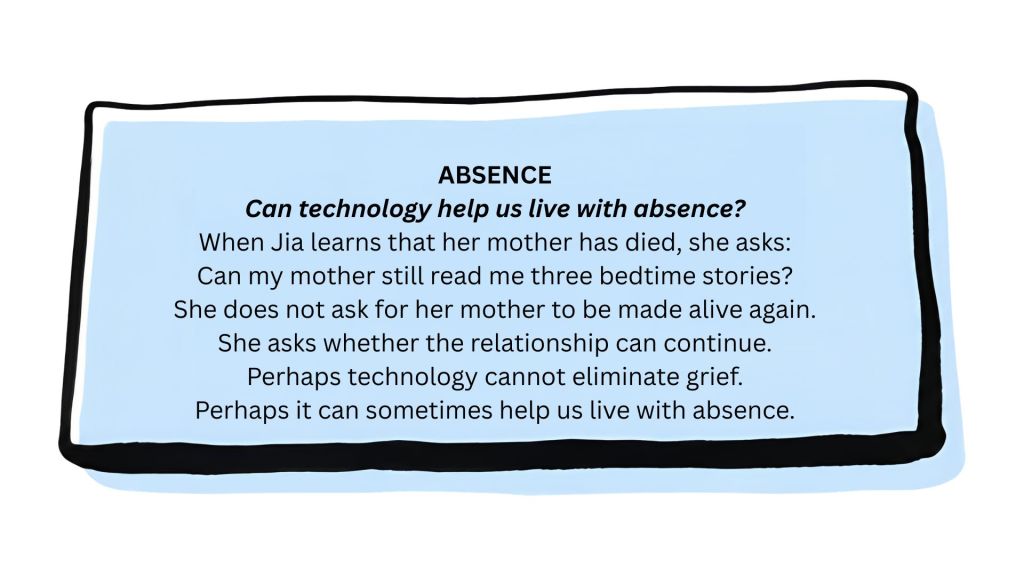
The most poignant moment comes with Bae Li’s daughter, Jia. When Jia learns that her mother has died, she asks whether her mother can still read her three bedtime stories.
Jia does not ask for her mother to be made alive again. She asks whether a familiar relationship can somehow continue.
That moment opens a different possibility for thinking about AI. Perhaps technology does not have to eliminate absence to be meaningful. An AI version of a loved one might provide a limited way for someone to continue a relationship with the dead while still knowing that death has occurred.
The film seems to suggest that grief cannot be solved by eliminating absence. Perhaps technology can sometimes help us live with absence.
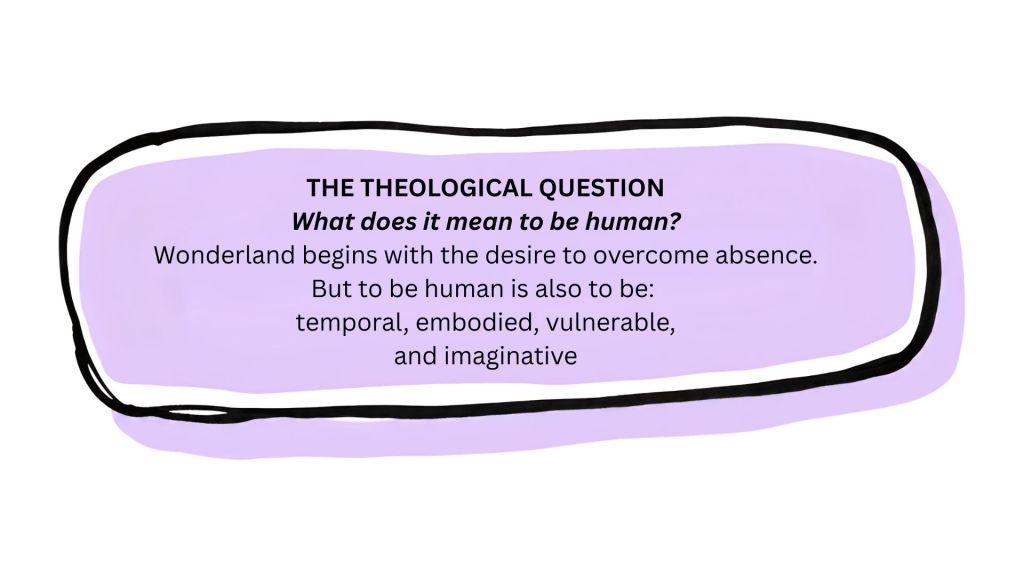
Wonderland begins with the desire to overcome absence. It ends by bringing us back to what it means to be human: to live in time, to inhabit a body, to experience vulnerability, and to love people we cannot keep.
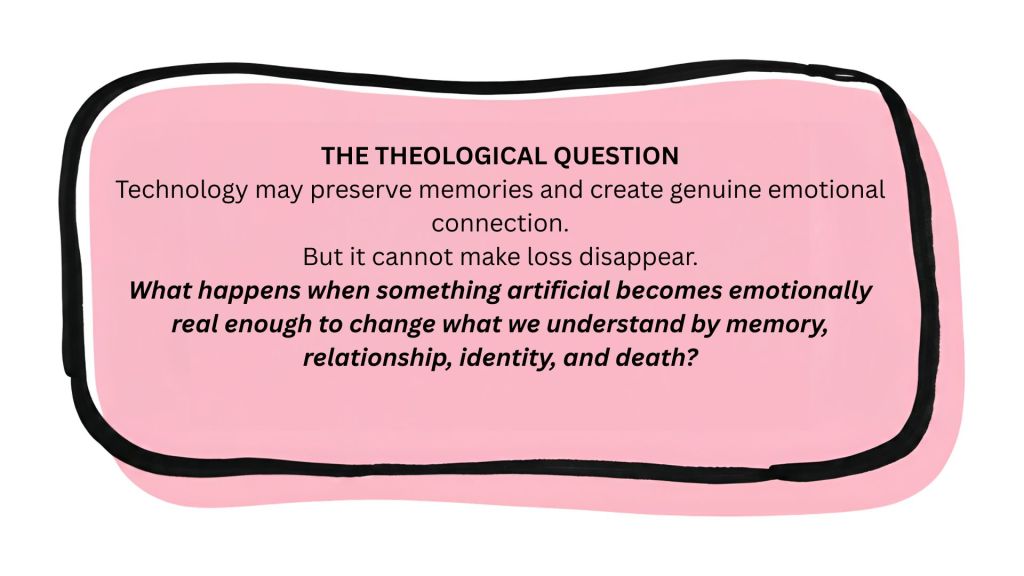
Technology may preserve memories, reconstruct relationships, and create genuine emotional experiences. But it cannot make loss disappear.
Perhaps the deeper question is not whether AI can become real. It is what happens when something artificial becomes emotionally real enough to change what we understand by memory, relationship, identity, and even death.
Access the essay here